Deep Cleaning vs Regular Cleaning Toronto: Honest Guide

The North York Couch That Changed How I Quote Cleans
A few months ago, a client in North York booked a regular clean before her in-laws arrived from Vancouver for a long weekend. The website form said two-bedroom condo, regular maintenance clean, no special requests.
We pulled up. Nice building. Friendly client. Within ninety seconds of walking in, I knew this wasn't a regular clean situation.
The fridge gasket had a black ring of mould. The top of the kitchen cabinets had a layer of dust you could write your name in. There was a faint pet smell that meant the carpet hadn't been deep-vacuumed in months. And when I asked her if I could move the living-room couch to check underneath — a Clean Papi standard for any first-time visit — she looked at me like I'd asked to read her diary.
"Has the couch ever been moved since you bought it?" I asked.
"…Probably not since 2022."
So I made the call I make about half the time on a first booking. I sat down with her at the kitchen table and explained that what she'd booked — a two-hour regular clean for $160 — was going to leave her embarrassed when her mother-in-law arrived. The fridge gasket alone would take 30 minutes. The cabinets would take another 45. The carpet needed an actual HEPA vacuum pass with the couch and dining table moved out of the way. None of that fits in a regular clean.
Twenty minutes later we'd booked a deep clean instead — $340, full team, full afternoon. Six hours later, the in-laws walked into a transformed apartment.
This is the conversation I have probably twice a week with clients in Toronto. Half the people who book a regular clean actually need a deep clean. They don't know it because nobody's told them. So let me tell you.
The Quick Answer (And Then We'll Get Into the Detail)
A regular clean is maintenance — the visible-surface refresh you book weekly, bi-weekly, or monthly to keep a home consistently fresh. It's designed to be repeatable in 2–4 hours.
A deep clean is a reset — a top-to-bottom, baseboard-to-ceiling-fan service that tackles built-up grime, hidden corners, and detail work. It takes 4–8 hours and costs roughly 1.7–2x a regular clean.
Most Toronto homes need a deep clean once or twice a year, with regular cleans in between. Almost every first-time client should start with a deep clean. The reason is simple: a regular clean assumes the home is already at a baseline. If the baseline isn't there, the cleaner spends the whole visit fighting buildup that never should've been their job.
Now the detail.
What Actually Happens in a Regular Clean
A regular clean — what we sometimes call a "maintenance" or "recurring" clean — focuses on the surfaces and rooms you use every day. The goal is consistency. Keep the home fresh between deeper services.
In a Clean Papi regular clean for a typical Toronto home, here's what we do:
Kitchen: Wipe counters, backsplash, stovetop, exteriors of fridge/oven/microwave/dishwasher. Quick wipe inside the microwave. Sink and faucet (Bar Keepers Friend on stainless). Sweep and mop. Empty garbage and recycling.
Bathrooms: Toilet inside and out. Shower, tub, tile (surface-level). Vanity, mirror, faucet. Empty trash. Mop the floor.
Living and bedrooms: Dust accessible surfaces. HEPA-vacuum carpets and rugs. Mop hardwood and luxury vinyl. Make beds (linens left out). Tidy visible flat-surface clutter.
General: Empty all bins. Wipe doorknobs, switches, handles. Quick wipe of any visible smudges on glass and stainless.
What's not in a regular clean: inside the oven, fridge, or microwave (deep). Baseboards (deep). Window sills and tracks (deep). Light fixtures and ceiling fans (deep). Inside cabinets and drawers (deep). Spot-cleaning walls (deep).
A regular clean for a 2-bedroom Toronto home runs $130–$200. A 3-bedroom is $170–$260. Recurring clients get a 5–10% discount because the unit stays at a baseline that takes less time to maintain over time.
What Actually Happens in a Deep Clean
A deep clean is the full reset. It includes everything in a regular clean, plus the work that takes muscle, time, and the right products.
This is where Clean Papi distinguishes itself. The places I find dirt most cleaning companies in Toronto skip:
Kitchen — deep:
-
Inside the oven (degreased, scrubbed, manufacturer-approved oven cleaner).
-
Inside the fridge and freezer, including the gasket (black mould lives there).
-
Inside the microwave.
-
Range hood and the stove vent filter (most landlords check this — most cleaners skip it).
-
Behind and under the stove. There's always something.
-
Inside cabinets and drawers (often a separate add-on).
-
Backsplash grout.
-
The detail work on the sink and drain. Bathrooms — deep:
-
Tile grout, scrubbed by hand or with a Waitbird steam cleaner.
-
Mould treatment in showers and around fixtures.
-
Limescale removal from showerheads, faucets, and glass (a vinegar bag overnight does the trick).
-
Inside the medicine cabinet and vanity drawers.
-
Exhaust fan grille (a major dust collector — and the spot every Toronto landlord checks during inspections).
-
Detailed baseboards. Living spaces and bedrooms — deep:
-
Baseboards. Hand-wiped or scrubbed.
-
Door frames, doors, and the top of the closet door frames (the flat edge most people don't even know exists).
-
Window sills and tracks.
-
Light fixtures and ceiling fans (take down the dome covers — there are dead flies, every time).
-
Inside closets (shelves, rods).
-
Vents and registers.
-
Wall spot-cleaning where needed. The Clean Papi signature spots — the ones I built our checklist around:
-
AC and HVAC filters. Toronto homes run forced air seven months a year. The filter collects dust, dander, and pollen until it's a felt mat. We pull it, vacuum it, reset it.
-
Dryer lint trap and vent. Lint is a fire hazard. Toronto Fire responds to dryer-vent fires every year.
-
Under the kitchen sink. That cabinet is an archaeology dig.
-
Under furniture. We move couches. We use our muscles. This is non-negotiable on a deep clean. If a cleaner doesn't move your couch, that's not a deep clean.
-
The inside of every appliance, following the manufacturer's guidelines. Self-clean cycles, descaling cycles, gasket wipes, drum tablets. We look up the manuals. Most cleaners don't. A deep clean for a 2-bedroom Toronto home runs $240–$380. A 3-bedroom is $300–$500. Move-in/move-out cleans (which are essentially deep cleans plus add-ons) run $300–$700 depending on condition.
Side-by-Side: How They Compare
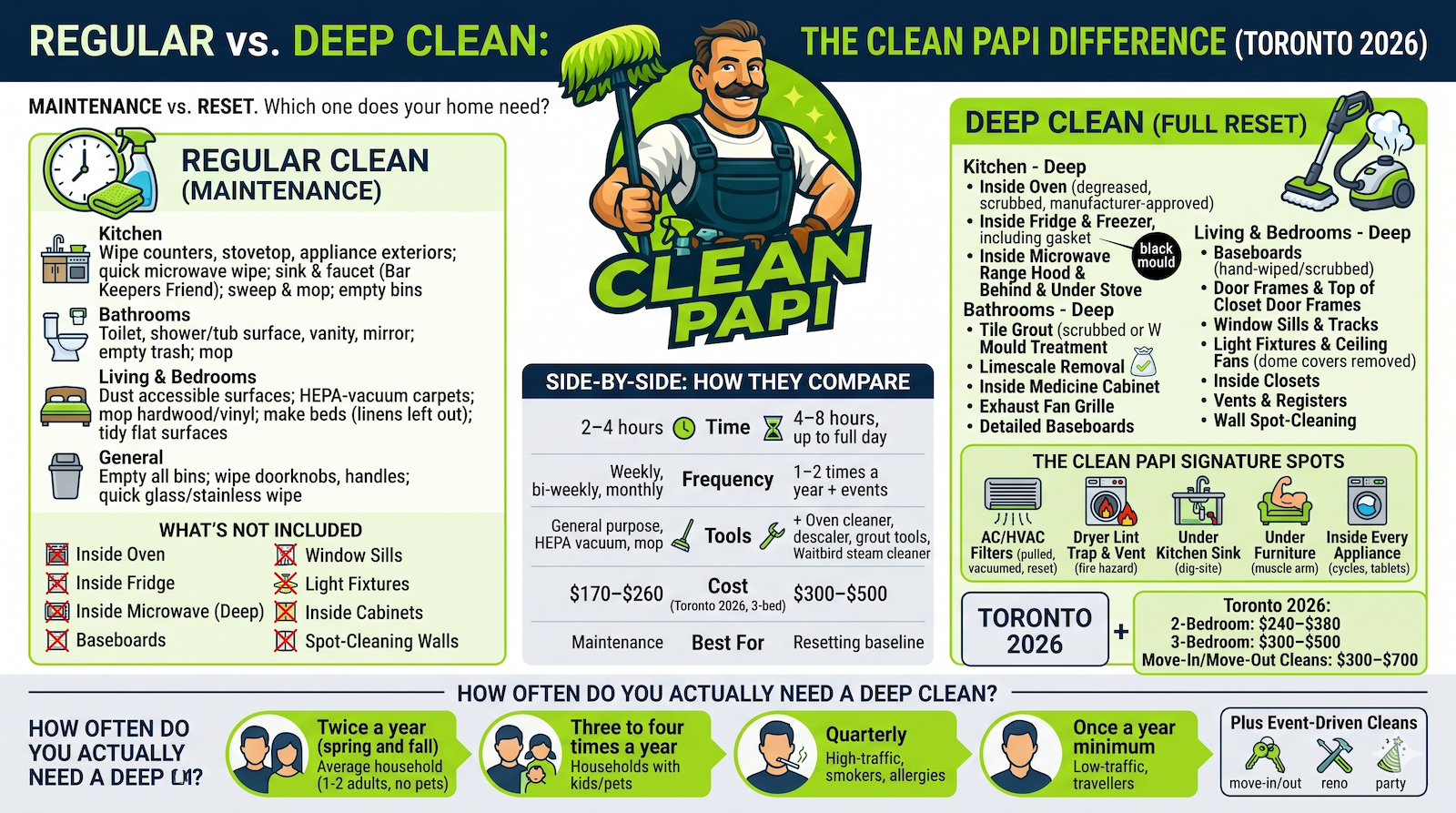
The dimensions that matter, in plain numbers:
Time: Regular clean is 2–4 hours. Deep clean is 4–8 hours, sometimes a full day for larger or heavily-soiled homes.
Frequency: Regular cleans happen weekly, bi-weekly, or monthly. Deep cleans happen 1–2 times a year, plus before move-in/move-out, post-renovation, or after a major life event.
Tools: Regular clean uses general-purpose cleaners, microfibre, HEPA vacuum, and a mop. Deep clean adds oven cleaner, descaler, mould treatment, grout scrubbing tools, and the Waitbird steam cleaner.
Cost in Toronto in 2026: Regular clean for a 3-bedroom is $170–$260. Deep clean is $300–$500. Roughly 1.7–2x.
Best for: Regular is for maintenance. Deep is for resetting the baseline.
How Often You Actually Need a Deep Clean
The honest answer depends on your household. Here's what I tell Clean Papi clients on the discovery call:
Twice a year (spring and fall) — for an average household with one or two adults and no pets. Spring catches winter dust, salt, and indoor buildup; fall preps for closed-window heating season.
Three to four times a year — for households with kids, pets, or both. More foot traffic, more food prep, more hair, more mess.
Quarterly — for high-traffic homes, smokers, or anyone with allergies or respiratory issues. Regular deep cleaning meaningfully reduces dust mites, pollen, and indoor allergens.
Once a year minimum — for low-traffic households (single occupants, frequent travellers, condo dwellers who rarely cook).
Plus event-driven deep cleans: before move-in/move-out, after renovations or construction, before a big party or hosting overnight guests, after a sick household member, or after extended pet boarding.
Toronto's Climate and Lifestyle Make Deep Cleaning Hit Different
A few realities specific to living in this city:
Salt and slush from November to April. Road salt and slush track into homes, eat at hardwood floors, and leave white residue on baseboards. Most Toronto homes I see at the end of winter need a baseboard deep clean, full stop.
Closed-window heating season (Oct–Apr). Forced-air heating circulates dust, pet dander, and indoor pollutants for seven months. By April, the dust on your light fixtures, ceiling fans, and the tops of cabinets is visible from across the room. That's when spring deep cleans pay for themselves.
Spring allergen season is brutal. Toronto's pollen and mould seasons are getting longer. A deep clean of carpets, upholstery, baseboards, and window tracks can meaningfully reduce indoor allergen load. I've had clients with chronic spring allergies tell me this is the single thing that made their April livable.
Condo HVAC quirks. Many Toronto condos have minimal ventilation, which traps moisture and creates faster mould buildup in bathrooms. Quarterly bathroom deep cleaning is worth budgeting for if you live in a downtown high-rise.
Pollution and city dust. Downtown and along the Gardiner/QEW corridors, fine dust and traffic pollution settle on window tracks, balconies, and exterior-facing surfaces faster than in the suburbs. Plan deep cleans accordingly.
How I Decide Which One to Recommend
Here's the framework I run through on every Clean Papi discovery call. You can run through it yourself.
You probably need a deep clean if:
- It's been more than 3 months since your last professional clean.
- You're booking a cleaning service for the first time.
- You're moving in or moving out.
- You just finished a renovation, painting, or major construction.
- The fridge gasket has visible mould or grime.
- The stove vent filter looks like a felt mat.
- The top of your kitchen cabinets has visible dust.
- You can't remember the last time the inside of the oven was cleaned.
- You have pets and it's been more than a season since a thorough clean.
- You're hosting overnight guests, family, or a special event.
- You've moved into a new place that's "clean" but doesn't feel like yours yet.
- Your home doesn't pass the "white-glove" test on baseboards, light fixtures, or window sills.
A regular clean is enough if:
- You've had a deep clean in the past 1–3 months.
- You're a recurring Clean Papi client.
- The home is small and lightly used (single professional in a 1-bedroom condo).
- You've kept up with surface cleaning between professional visits.
When in doubt, start with a deep clean for your first booking, then transition to recurring regular cleans. The deep clean establishes the baseline. The regular clean keeps it there. This is the path 90% of new Clean Papi clients end up on, and it's the one I'd recommend to my own family.
What "Stand-Alone" vs "Recurring" Looks Like
You don't have to commit to recurring service to book either type.
Stand-alone deep clean: A one-time service. Common reasons: spring or fall reset, hosting an event, post-renovation, post-illness, prepping for sale or new tenants. No commitment.
Stand-alone regular clean: A one-time service for a home already in good shape — before company arrives, or as a quick break from cleaning yourself.
Recurring regular clean: Weekly, bi-weekly, or monthly. Bi-weekly is by far the most popular structure for Toronto clients.
Recurring with periodic deep clean: The most common professional setup — bi-weekly regular cleans plus a deep clean every 6 months (or quarterly for busy households). This is the Clean Papi default recommendation for most clients.
If you're not sure where to start, I tell every new client the same thing: book a one-time deep clean first. Evaluate the experience. Decide if recurring service makes sense. There's zero obligation to commit upfront.
How to Get the Most Out of Whichever You Book
A few small things that significantly improve the result of any clean:
Tell us your three priorities. Every home has 2–3 areas that matter most. Maybe it's the master bathroom that's been bothering you for six months. Maybe the kitchen baseboards. Tell us in the call. We allocate time accordingly.
Declutter, don't pre-clean. Cleaners clean. We don't tidy. Pick the laundry off the floor, clear the counters, put dishes in the sink. Don't scrub the tub before we arrive — that's literally what you're paying us for.
Mention pets, allergies, surfaces. Hardwood, marble, and leather all need specific products. Cats need essential-oil-free everything. Babies on the floor change which products we use. Tell us up front.
Allow extra time for first cleans. A first-time clean — especially a deep one — usually takes longer than estimated. Build buffer into your day.
Trust the process. A real deep clean of a long-neglected home transforms how it feels to live there. Don't underestimate the difference.
When to Just Pick Up the Phone
If any of the following apply, your home is overdue for a deep clean and a regular service won't get you there:
- You can't remember the last time the inside of your oven was cleaned.
- You moved into a place months ago and it still doesn't feel like yours.
- You're allergic to your own home in spring.
- You finished a reno and dust is in places you didn't know existed.
- You're prepping to host the in-laws and want it to actually look hosted. Request a deep cleaning quote. We'll call you, ask about your home and priorities, and send you a price range the same day. Final invoice is calculated on actual time + materials + 35% margin — usually under the estimate. CGL certificate available before you put down a deposit.
— Nathan Founder, Clean Papi
Frequently Asked Questions
What's the difference between deep cleaning and regular cleaning?
A regular clean focuses on visible, frequently-used surfaces — counters, floors, mirrors, accessible dusting — and is designed to maintain a clean home between deeper services. A deep clean includes everything in a regular clean plus baseboards, inside the oven and fridge, inside cabinets, light fixtures, window tracks, grout, and other detail work that takes 2–3x as long.
How often should I deep clean my house in Toronto?
Most Toronto homes benefit from a professional deep clean 1–2 times per year, plus event-driven deep cleans (move-in/move-out, post-renovation, after illness, before hosting). Households with pets, kids, or allergies often deep clean quarterly. Single occupants or low-traffic homes can usually deep clean once a year.
How much does deep cleaning cost in Toronto in 2026?
A deep clean for a 2-bedroom Toronto home costs $240–$380. A 3-bedroom runs $300–$500. Move-in/move-out deep cleans run $300–$700. Pricing depends on size, number of bathrooms, condition, and add-ons like inside cabinets or carpet cleaning.
How long does a deep clean take?
A Clean Papi team of two typically completes a deep clean in 4–8 hours. A 1-bedroom condo may take 4–5 hours. A heavily-soiled 3-bedroom can take 7–9 hours or be split across two days.
Should my first house cleaning service be a deep clean or a regular clean?
A deep clean. Almost every reputable Toronto cleaning company recommends it for the first visit because it establishes the baseline a recurring service can maintain. Booking a regular clean as your first service often leaves clients disappointed because the cleaner is constrained on time and can't address the buildup that accumulated before they arrived.
What does Clean Papi clean during a deep clean that other cleaners skip?
The hidden spots most cleaners ignore: AC and HVAC filters, dryer lint traps and vents, under the kitchen sink, light fixtures, ceiling fans, the fridge gasket, the stove vent filter, and under the couch — we move it. Every deep clean. We also follow appliance manufacturer guidelines for ovens, fridges, washers, and dryers.
Is deep cleaning worth the extra cost?
For first-time cleans, move-outs, post-renovation, or homes that haven't been deep-cleaned in 6+ months, yes. The deep clean costs about 1.7–2x a regular clean but addresses 5–10x the surface area and grime. For homes already on a recurring schedule, a regular clean is more cost-efficient.
Do I need to be home during a deep clean?
No. Most Toronto homeowners give us access via key, lockbox, or smart-lock code, then leave for work or errands. Deep cleans take longer, so plan to be away for most of the day if possible. We're fully insured, every cleaner is on our team, and every visit is documented with before-and-after photos.
How do I prepare my home for a deep clean?
Declutter (don't pre-clean), secure valuables and prescription medication, communicate any allergies or pet concerns, and tell the team your top 3 priority areas. If certain surfaces require specific care (marble, granite, hardwood, leather), mention that during booking so the team brings the right products.
Need Professional Help?
Let Toronto's most trusted cleaning team handle the dirty work. Get an instant price estimate — no phone call required.
Related Articles
Move In/Move Out Cleaning for July 1st in Toronto
July 1st moving cleaning in Toronto made easy. Clean Papi handles move in/move out cleaning, deep cleaning, oven scrubs, grout and mold removal so you get your tenant deposit back. Book in 60 seconds.
Services & InfoWasher and Dryer Deep Cleaning in Toronto: The Job That Quietly Prevents House Fires
Clean lint trap, smelly washer, dryer that takes two cycles to finish a load? Here's how Clean Papi deep-cleans Toronto washers and dryers — including the dryer vent that almost burned down an Etobicoke laundry room.
Services & InfoAirbnb Cleaning Toronto: A Host's Guide to Turnovers That Protect Your Superhost Status
Toronto Airbnb host? One missed hair can cost you Superhost status — and a third of your bookings. Here's how Clean Papi runs short-term rental turnovers, and what to ask before you hire any STR cleaner.