Post-Construction Cleaning Cost in Toronto (2026) + Checklist

By the Clean Papi team, Toronto. Last updated September 28, 2026.
Quick answer: Post-construction cleaning is a multi-phase clean done after a renovation or new build to remove fine drywall dust, debris, paint splatter, adhesive residue and protective film so a space is safe and ready to live or work in. In Toronto, it typically costs $400 to $800 for a single-room condo reno, $800 to $1,500 for a kitchen or bathroom reno and $1,500 to $3,500 or more for a whole-home renovation, and most homes take one crew one full day. The key difference from a regular clean is equipment: fine construction dust needs HEPA-filtered vacuums, which capture at least 99.97% of particles at 0.3 microns.
What is post-construction cleaning?
Post-construction cleaning (also called post-renovation cleaning, builder's clean, or construction cleanup) is the professional cleaning that happens after trades finish work and before people move back in. It removes the residue a renovation leaves behind: drywall and joint compound dust, sawdust, grout haze, paint drips, caulk smears, stickers on new fixtures, and the grey film that settles on every horizontal surface.
If you have ever renovated a kitchen, a bathroom or a whole house in Toronto, you know the feeling. The contractor sweeps up, loads the bin, and says "you're all set." Then you run a finger along the top of a door frame and it comes back white. You wipe the counter and an hour later there is dust on it again. That is not bad cleaning. That is how construction dust behaves.
We are Clean Papi, a Toronto cleaning company that does residential, commercial and post-construction work across the GTA. This guide is everything we have learned from doing post-renovation cleans in condos, semis and large detached homes: what the job actually involves, why the dust matters for your health, what it costs, how long it takes, and how to avoid the mistakes we see most often. No fluff, just what we do on the job.
Key facts at a glance
| Question | Short answer |
|---|---|
| Typical Toronto cost | $400 to $800 (single room) up to $3,500+ (whole home) |
| Typical hourly rate | About $49 to $60 per labour hour |
| Typical time | 1 crew, 1 day for most homes |
| Must-have equipment | HEPA vacuum, HEPA air scrubber, microfibre |
| Best timing | After all trades are finished, before furniture moves in |
| Number of phases | 3: rough clean, detail clean, final touch-up |
How is post-construction cleaning different from a regular or deep clean?
A regular clean maintains a space that is already clean. A deep clean resets a lived-in space. A post-construction clean removes material that was never supposed to be there: fine mineral dust, adhesives, paint and debris, often from surfaces that have never been cleaned before.
| Regular clean | Deep clean | Post-construction clean | |
|---|---|---|---|
| What it removes | Everyday dust, grime, hair | Built-up grease, soap scum, neglected areas | Drywall dust, sawdust, grout haze, paint, adhesive, stickers, film |
| Equipment | Standard vacuum, cloths | Standard vacuum, degreasers | HEPA vacuum, HEPA air scrubber, scrapers, microfibre system |
| Surfaces covered | Visible, reachable | Adds inside appliances, baseboards | Every surface, including inside cabinets, vents, tracks, ledges, ceilings |
| Passes needed | One | One | Usually two or three phases |
| Typical Toronto rate | Lower | About $60 per labour hour | About $49 to $60 per labour hour |
The biggest difference is how the dust behaves. Household dust is mostly fibres and skin cells. It is relatively heavy and lands quickly. Construction dust is ground-up mineral: gypsum, calcite, mica, talc and sometimes silica. The particles are so fine they stay suspended in the air for hours, drift into HVAC returns, and resettle after you clean. A regular vacuum without a sealed HEPA system will pull that dust in one end and blow the finest part straight back out the exhaust.
What are the three phases of post-construction cleaning?
Professional post-construction cleaning is done in three phases: a rough clean to remove debris and heavy dust, a detail clean to clean every surface top to bottom, and a final touch-up to catch the dust that resettles. Skipping phases is the most common reason a "cleaned" renovation still looks dusty a day later.
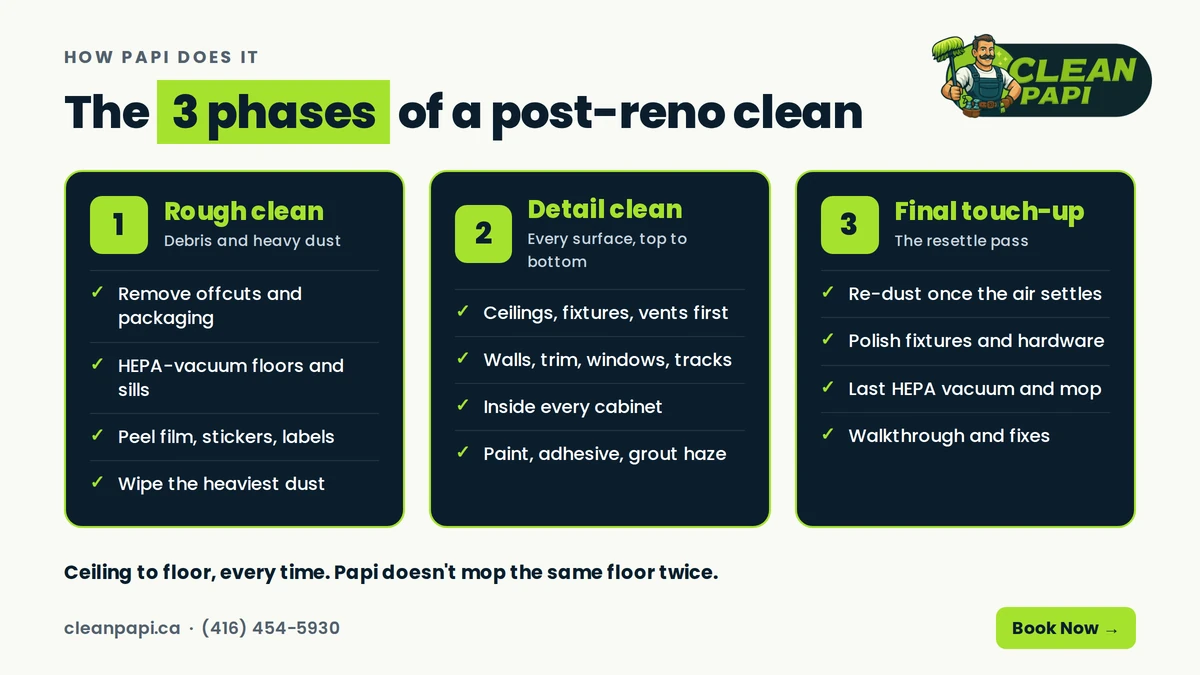
- Rough clean (debris and heavy dust). Remove leftover construction materials, offcuts, packaging and loose debris. Sweep, then HEPA-vacuum floors, sills and ledges. Peel protective film and remove stickers and labels from windows, appliances and fixtures. Wipe down the heaviest dust so the detail crew is not just moving it around. On many jobs the general contractor or homeowner handles part of this phase, and that should be agreed in writing before the clean is booked.
- Detail clean (every surface, top to bottom). Dust ceilings, light fixtures, vents and the tops of door frames first, then walls, trim, windows, cabinets and counters, and floors last. Remove paint splatter and adhesive residue with the right tool for each surface. Clean inside every cabinet, drawer and closet, because drywall dust gets inside even closed doors. Deep clean kitchens and bathrooms, including grout haze on new tile. Clean windows inside and out where reachable, including tracks and frames.
- Final touch-up (the resettle pass). After the air settles, often the same evening or the next morning, do a final dusting of horizontal surfaces, polish fixtures and hardware, and give the floors a last HEPA vacuum and mop. Then walk through the space with the client or contractor and fix anything flagged.
Why top to bottom matters: dust falls. If you wash the floor before you dust the light fixtures, you will be washing the floor twice. Our crews follow a written dust-removal procedure that starts at the ceiling and works down, room by room, and ends at the exit door so no one walks across a finished floor.
Is construction dust harmful to your health?
Yes. Construction dust is not just a cosmetic problem. According to the U.S. National Institute for Occupational Safety and Health (NIOSH), drywall joint compound contains talc, calcite, mica, gypsum and silica, and breathing the dust can cause eye, nose, throat and airway irritation, coughing, and breathing difficulties similar to asthma. When crystalline silica is present, the risks are more serious.
What is in renovation dust?
- Drywall and joint compound dust: gypsum, calcite, mica, talc and sometimes silica. This is the fine white powder that coats everything after sanding. NIOSH found drywall sanders exposed to as much as 10 times the permissible limit for total dust.
- Crystalline silica: found in concrete, mortar, brick, stone, tile and some countertop materials. Cutting, grinding or drilling these releases respirable silica.
- Sawdust: from framing, trim and flooring. Some engineered wood products also contain binders and resins.
- Paint and primer particles: from sanding and overspray. In older Toronto homes, sanding original painted surfaces can disturb lead-based paint, which is a separate hazard that should be handled by the contractor before cleaning begins.
Why silica matters
The Government of Ontario's guidance on silica on construction projects states that prolonged inhalation of respirable crystalline silica can cause silicosis, a progressive scarring of the lungs, and that the International Agency for Research on Cancer classifies crystalline silica as a Group 1 carcinogen. The dangerous particles are microscopic and can lodge deep in the lungs. The damage is irreversible and can continue to progress after exposure ends.
A homeowner cleaning up after a kitchen reno is not a tile cutter breathing silica every day. But fine dust that stays in carpets, vents and upholstery gets stirred up every time someone walks through, which matters most for babies, older adults, pets, and anyone with asthma or allergies. The goal of a proper post-construction clean is to capture the dust and remove it from the home, not just move it around.
Why HEPA filtration is non-negotiable
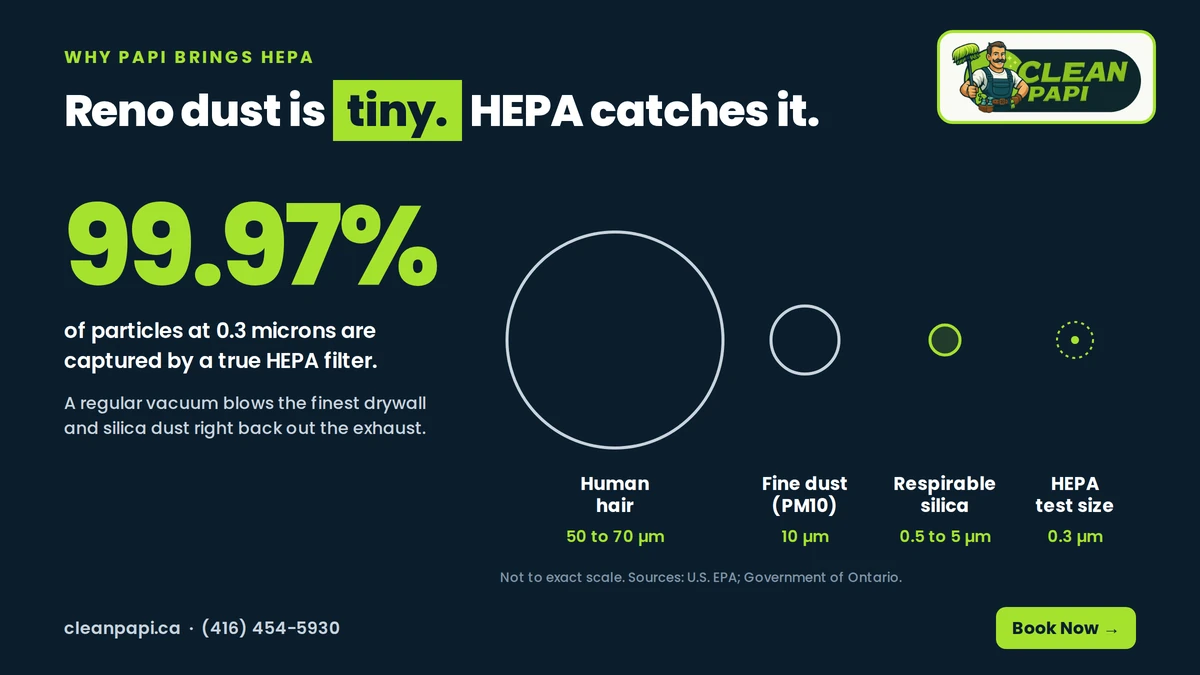
The U.S. Environmental Protection Agency describes a HEPA (high efficiency particulate air) filter as one that can remove at least 99.97% of airborne particles 0.3 microns in size, and particles larger or smaller than that are trapped even more efficiently. That is exactly the size range of the finest drywall and silica dust.
This is why we build every post-construction crew kit around:
- A commercial HEPA vacuum with a sealed system, so air does not bypass the filter. Our crews use a shop vacuum fitted with a certified HEPA filter upgrade.
- A HEPA air scrubber running during the clean to pull suspended dust out of the air before it resettles.
- Microfibre cloths and mops that trap dust in the fibres instead of pushing it around. We rotate to fresh cloths constantly rather than rinsing and reusing a dusty one.
- Damp wiping, not dry dusting, on most surfaces, so fine powder is lifted instead of launched back into the air.
A quick test you can do yourself: turn off the lights, close the blinds and shine a phone flashlight sideways across the room. If you can see a haze floating in the beam, the air is still full of fine dust and the job is not done.
What should a post-construction cleaning checklist include?
A complete post-construction checklist covers every room from ceiling to floor, including the inside of cabinets, closets, vents and window tracks. Use the checklist below to plan a DIY clean or to check that a cleaning company's quote covers everything.
Every room
- Ceilings and corners: dust and cobwebs, especially around new pot lights
- Light fixtures, fans and switch plates: dust, wipe, remove stickers
- Vents, returns and registers: remove covers, vacuum inside the duct opening, wash covers
- Tops of door frames, window casings and crown moulding
- Walls: HEPA-vacuum or damp wipe to remove sanding dust (test a hidden spot first on fresh paint)
- Doors: both sides, top edge, hinges and hardware
- Baseboards and trim: dust, then damp wipe, then remove caulk and paint smears
- Windows: glass inside and out where reachable, frames, sills and tracks; remove stickers, tape residue and paint specks
- Closets: shelves, rods and floor
- Floors: HEPA vacuum, then the correct cleaner for the floor type, edges and corners by hand
Kitchen
- Inside and outside every cabinet and drawer, including hinges and shelf pins
- Countertops and backsplash, including grout haze on new tile
- Sink, faucet and drain area; remove plumber's putty and silicone smears
- Appliances: remove protective film and labels, wipe inside and out, clean fridge and dishwasher door seals
- Range hood and filter; stovetop and inside the oven if new or used during the reno
- Toe kicks under the lower cabinets, where dust collects out of sight
Bathrooms
- Tile and grout: remove grout haze and thinset residue
- Tub, shower, glass door and tracks; remove silicone smears
- Toilet inside and out, including the base and behind it
- Vanity inside and out, mirror, medicine cabinet
- Fixtures and shower heads: polish and remove stickers
- Exhaust fan cover: remove and wash
Stairs, basements and common areas
- Stair treads, risers and railings, including spindles one by one
- Basement mechanical area and around the furnace: HEPA vacuum only, do not blow dust around
- Laundry area: behind and on top of the machines
- Entryways and garage access doors
After the clean
- Replace the furnace filter. It has been catching renovation dust for weeks. A fresh filter stops the system recirculating it.
- Run the HVAC fan for a day with the new filter, then check the filter again.
- Consider a duct cleaning if the system ran without protection during sanding.
On large homes, the checklist gets long fast. A recent post-renovation clean we quoted was a five-bedroom, five-bathroom house with three staircases, about 35 windows with paint spots and between 80 and 120 shelves to clean. That kind of detail is why a proper walkthrough before quoting matters, and why we count shelves, windows and staircases, not just bedrooms.
How much does post-construction cleaning cost in Toronto?
In Toronto, post-construction cleaning usually costs $400 to $800 for a single-room reno in a condo, $800 to $1,500 for a kitchen or full bathroom reno in a condo or smaller home, and $1,500 to $3,500 or more for a whole-home renovation. Most companies price by the labour hour, and Clean Papi's post-construction rate is $60 per labour hour, reduced to $49 per labour hour on large jobs.
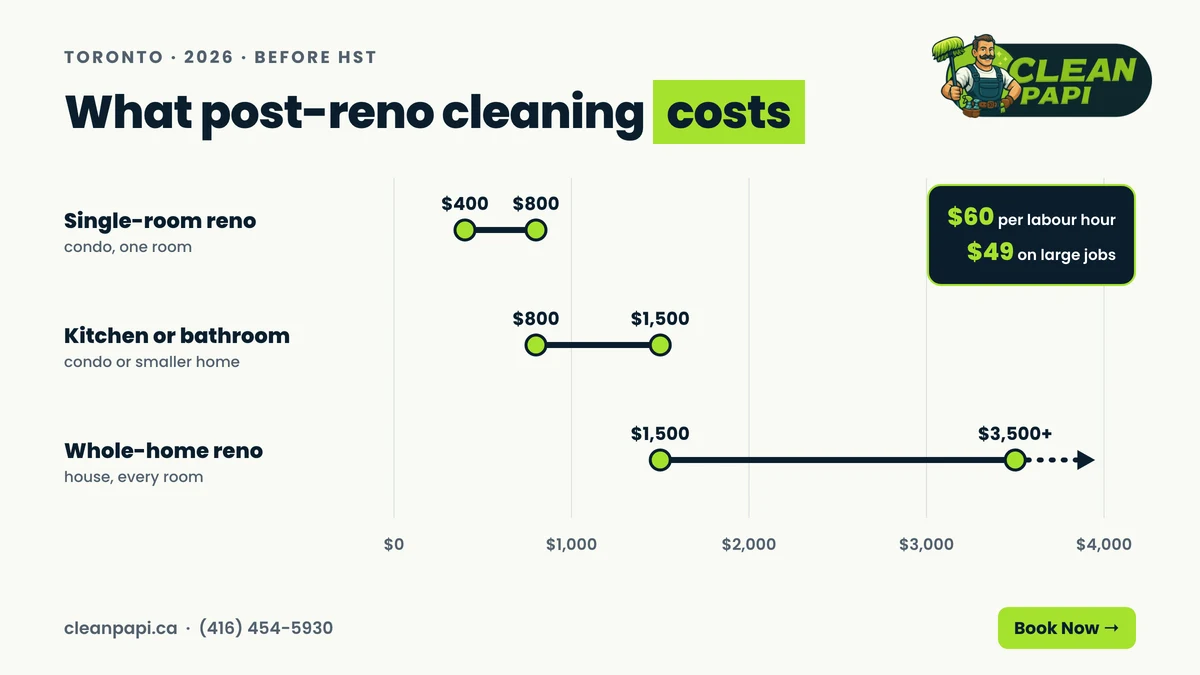
Clean Papi post-construction pricing (2026, before HST)
| Renovation | Scope | Typical price (CAD) |
|---|---|---|
| Single-room reno | One room in a condo, like a bedroom or small bath | $400 to $800 |
| Kitchen or full bathroom reno | Condo or smaller home | $800 to $1,500 |
| Whole-home renovation | House, every room | $1,500 to $3,500+ |
| Multi-unit or builder projects | Per sq ft | About $0.30 to $0.50 per sq ft (rough, detail and final) |
See current rates on our pricing page and the post-construction cleaning service page.
How is post-construction cleaning priced?
There are three common pricing models in the GTA:
- Per labour hour. You pay for the hours each cleaner works. Two cleaners for five hours is 10 labour hours. This is the most honest model for renovation work because nobody knows exactly how much dust is behind every cabinet door until the crew is inside. Our post-construction rate is $60 per labour hour, with a lower rate of $49 on high-hour jobs.
- Flat rate. A fixed price agreed after a walkthrough or photos. Good for predictability, but the company builds a buffer into the price to cover surprises.
- Per square foot. Common for builders, property managers and multi-unit projects where the scope is repeatable from unit to unit.
Many companies, including us, combine these: an estimate range based on labour hours, with a cap so you know the most you will pay. For example, a large five-bedroom, five-bathroom home we recently quoted was scoped at five cleaners for one full day at $49 per labour hour, capped at $1,900 plus tax.
What affects the price?
| Factor | Why it changes the price |
|---|---|
| Square footage and number of floors | More surface area, more stairs, more hauling of equipment |
| Number of bathrooms and kitchens | The most detail-heavy rooms, with tile, grout and fixtures |
| Amount of paint splatter, caulk and adhesive | Scraping and solvent work is slow and careful |
| Number of windows and whether tracks and frames are included | Window detail can double the time in a room |
| Whether the rough clean is done | If heavy debris is still on site, that is extra hours or a separate phase |
| How much sanding happened | A full drywall job leaves far more dust than a floor refinish |
| Access and parking | Downtown condos with loading dock bookings and paid parking add time and cost |
| Deadline | Same-day or next-day service before a closing or move-in may cost more |
Why quotes can change on the day
This is the part most companies do not talk about. Renovation cleans are easy to underestimate from photos. On one downtown condo job, we quoted two cleaners for four to six hours, 8 to 12 labour hours. Once on site, the scope grew to include upholstery and scrubbing grout haze off the kitchen floor, and the job took 21 labour hours. The lesson for both sides: agree on the exact scope in writing before the clean starts, and agree on how extra work will be approved and billed if something new comes up. A good company will call you before going over, not after.
How long does post-construction cleaning take?
Most post-construction cleans take one crew one day. A condo up to 800 sq ft usually takes two cleaners four to six hours, a 1,500 to 2,500 sq ft house takes a crew of three to four most of a day, and a large multi-level home can take a crew of five a full day or more. Heavy debris, lots of paint splatter or many windows add time.
| Space | Typical crew | Typical time on site |
|---|---|---|
| Single bathroom or kitchen reno | 1 to 2 cleaners | 3 to 5 hours |
| Condo up to 800 sq ft | 2 cleaners | 4 to 6 hours |
| 1,500 to 2,500 sq ft house | 3 to 4 cleaners | 6 to 8 hours |
| 2,500+ sq ft, multiple floors | 4 to 5 cleaners | 1 full day, sometimes 2 |
These are ranges, not promises. As the condo example above shows, scope changes on the day can double the hours.
When should you book a post-construction clean?
Book the clean for after all trades are completely finished, including the painter's last touch-ups, the electrician's cover plates and the flooring installer's transitions, and before furniture moves back in. Every trade that comes back after the clean brings new dust with it.
A timeline that works well:
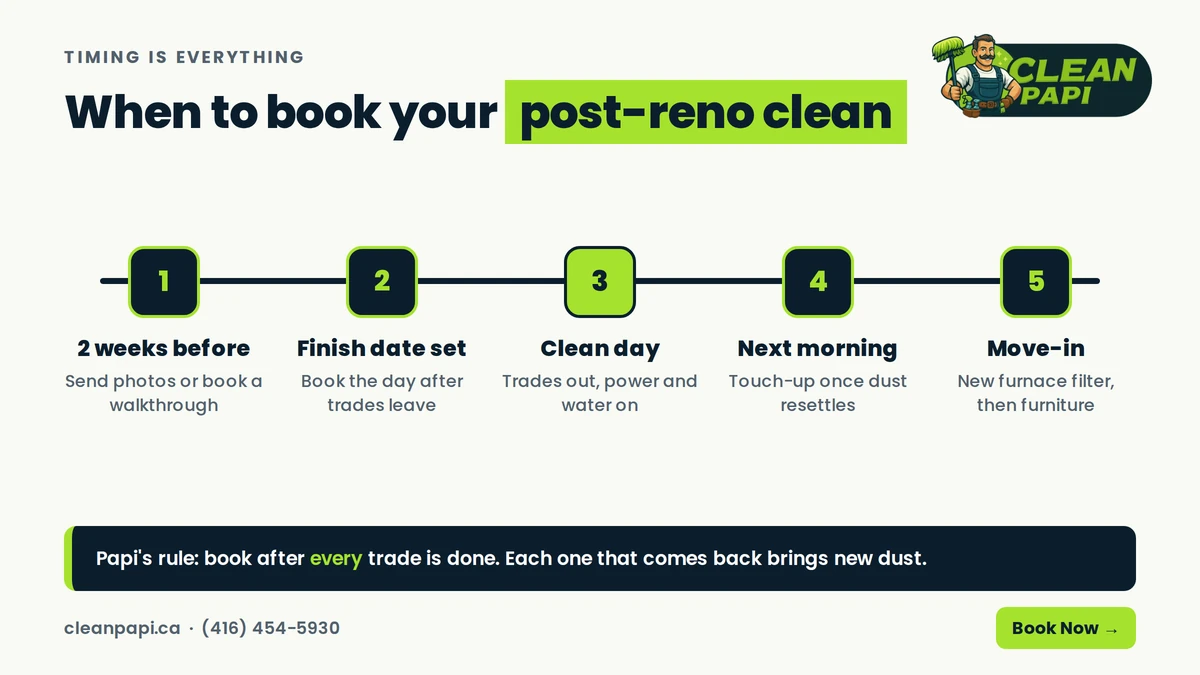
- Two weeks before completion: send the cleaning company photos or book a walkthrough so they can quote accurately.
- When the contractor confirms the finish date: lock in the cleaning date, ideally the day after the trades leave.
- Day of the clean: trades are out, power and water are on, windows can be opened for ventilation.
- Same day or next morning: final touch-up pass after dust resettles.
- After the clean: replace the furnace filter, then move furniture in.
On some jobs, the site is not fully finished when the clean is booked. On one large home we scoped, the windows were still taped, floor protection was still down and trim had not been installed. In that situation, agree who removes tape and floor protection and when. Old painter's tape that has been on for weeks can flake and pull paint or drywall paper when it comes off, and that damage is easy to blame on whoever touched it last. Photograph the site before the clean starts.
Can you do post-construction cleaning yourself?
You can DIY a small job, like a single bathroom or a closet build, if you have a HEPA vacuum, plenty of microfibre, and the patience to go top to bottom and then do it again the next day. For a full kitchen, a basement finish or a whole-home renovation, a professional crew is usually faster, cheaper per hour of your time, and safer because of the equipment.
| DIY | Professional crew | |
|---|---|---|
| Cost | Supplies and equipment rental | About $400 to $3,500+ in Toronto |
| Equipment | Household vacuum unless you rent a HEPA unit | Commercial HEPA vacuum, air scrubber, scrapers, microfibre system |
| Time | Often a full weekend plus touch-ups | Usually one day |
| Risk to new finishes | Higher: wrong scraper or cleaner can scratch glass, stone or new floors | Lower, with trained crews and insurance |
| Dust exposure | You breathe it | Crew uses proper equipment |
If you do it yourself: wear a properly fitted N95 or better respirator, never dry-sweep fine dust, use a HEPA vacuum (not a regular household vacuum), damp-wipe instead of dry-dusting, work top to bottom, and change your furnace filter when you are done. Test any solvent or scraper on a hidden spot first, especially on new hardwood, natural stone and painted surfaces.
What are the most common post-construction cleaning mistakes?
The most common mistakes are cleaning before the trades are finished, using a regular vacuum on drywall dust, dry-dusting, cleaning floors first, and not agreeing on scope in writing. Each one either wastes the clean or damages new finishes.
- Booking the clean too early. If the painter comes back for touch-ups or the electrician sands a patch, you are paying for a second clean.
- Using a household vacuum. Fine drywall dust clogs standard filters and passes through them. It can also burn out the motor. Use a sealed HEPA vacuum.
- Dry dusting and sweeping. A broom or feather duster launches fine particles back into the air. Damp wipe and HEPA vacuum instead.
- Cleaning bottom to top. Floors first means floors twice. Always start at the ceiling.
- Scraping the wrong surface with the wrong tool. A razor blade is fine on flat glass held at a low angle with lubricant, but it will scratch coated glass, natural stone and many new floors. Test first.
- Using harsh chemicals on new finishes. Fresh paint, sealed grout, natural stone and engineered hardwood each need specific, gentle cleaners. Acidic cleaners can etch marble and damage grout sealer.
- Forgetting inside cabinets, drawers and closets. Dust gets inside closed doors. It will end up on your dishes and clothes.
- Ignoring the HVAC system. A dusty furnace filter will spread renovation dust through the house for weeks.
- No photos before the clean. If there is pre-existing damage, like chipped paint around window tape or scratches on a new floor, photograph it before anyone starts cleaning so there is no dispute later.
- Vague scope. "Clean the house" means something different to everyone. List rooms, windows, cabinets, add-ons and who handles debris removal.
How do you choose a post-construction cleaning company in Toronto?
Choose a company that uses HEPA equipment, carries commercial general liability insurance and a WSIB clearance, gives a written scope and price range before starting, and offers a walkthrough or re-clean guarantee. Ask these questions before you book:
- Do you use HEPA vacuums and air scrubbers? If the answer is vague, move on.
- Can you send a Certificate of Insurance (COI) and a WSIB clearance certificate? In Ontario, a WSIB clearance shows the company is registered and in good standing with the Workplace Safety and Insurance Board. Builders, property managers and condo boards often require both before anyone steps on site.
- Is the price per labour hour, flat or per square foot, and is there a cap?
- What exactly is included? Inside cabinets? Windows inside and out? Window tracks? Paint removal? Debris hauling?
- Who removes tape, floor protection and stickers?
- What happens if a trade comes back and makes more dust?
- Do you do a final walkthrough, and will you come back if something is missed?
- Are the cleaners employees or subcontractors, and are they trained on post-construction work specifically?
- Is HST included, and is your HST number on the invoice?
How Clean Papi does post-construction cleaning
Clean Papi is a Toronto-based cleaning company (Clean Papi Inc.) offering residential, commercial and post-construction cleaning across the GTA. Here is what you get when you book a post-renovation clean with us:
- A written scope and estimate range based on your home's size, bathrooms, windows, shelves and staircases, with photos or a walkthrough for larger jobs.
- Three-phase cleaning: rough clean (or detail-only if your contractor already did the rough clean), detail clean and final touch-up.
- HEPA equipment on every job: commercial HEPA vacuum, HEPA air scrubber, microfibre system and professional window tools for paint and sticker removal.
- A written crew procedure for dust removal from ceilings, walls and ledges, so every crew cleans in the same order to the same standard.
- Insurance and compliance: commercial general liability insurance and an active WSIB account, with a COI and clearance available on request.
- Walkthrough guarantee: if something is missed, we come back and make it right at no extra charge.
- Service areas: Downtown Toronto (Liberty Village, King West, Leslieville, Riverdale, The Beaches, Cabbagetown, Yorkville, The Annex), North York, Etobicoke, Scarborough, Vaughan, Markham, Richmond Hill, Mississauga and surrounding GTA neighbourhoods.
We work with homeowners after a renovation, realtors preparing a listing, contractors and builders who need a handover clean, and property managers turning over units.
Post-construction cleaning FAQ
How much does post-construction cleaning cost in Toronto?
Post-construction cleaning in Toronto typically costs $400 to $800 for a single-room condo reno, $800 to $1,500 for a kitchen or bathroom reno, and $1,500 to $3,500 or more for a whole-home renovation, before HST. Clean Papi charges $60 per labour hour, or $49 per labour hour on large jobs.
What is included in a post-construction clean?
A post-construction clean includes debris removal, HEPA vacuuming of every surface, removal of stickers, film, paint splatter and adhesive, dusting of ceilings, fixtures, vents and trim, cleaning inside cabinets and closets, window cleaning including tracks, deep cleaning of kitchens and bathrooms, and a final touch-up pass after the dust resettles.
What is the difference between a rough clean and a final clean?
A rough clean removes construction debris and heavy dust during or right after construction. A final clean, also called a detail clean, happens after all trades are finished and cleans every surface top to bottom so the space is move-in ready.
How long after a renovation should I wait to clean?
Clean as soon as all trades are completely finished, ideally the next day. Waiting longer lets dust settle deeper into carpets, vents and upholstery. Plan a final touch-up the same evening or next morning to catch resettled dust.
Why does dust keep coming back after cleaning?
Fine drywall and construction dust stays suspended in the air for hours and hides in vents, tracks and the furnace filter. It keeps resettling until it is captured with HEPA vacuums and air scrubbers and the furnace filter is replaced.
Is drywall dust dangerous?
Drywall joint compound dust contains talc, calcite, mica, gypsum and sometimes silica. NIOSH reports it can cause eye, throat and airway irritation and asthma-like symptoms. Silica dust from concrete, tile and stone can cause silicosis with prolonged exposure. Use HEPA equipment and a respirator.
Can a regular vacuum pick up drywall dust?
Not safely. Household vacuums without a sealed HEPA system let the finest particles pass through the filter and back into the air, and drywall dust can clog filters and damage the motor. Use a HEPA vacuum rated to capture 99.97% of particles at 0.3 microns.
Do post-construction cleaners remove paint from windows?
Yes. Professional crews remove paint specks, stickers, tape residue and adhesive from glass, frames and sills using window scrapers, lubricant and the right solvents for each surface. Coated or tinted glass needs extra care, so ask the company how they handle it.
Do I need to be home during the clean?
No, as long as the crew has access, power and running water. Many clients leave a lockbox code or coordinate with their contractor. We recommend being available for the final walkthrough.
Does post-construction cleaning include garbage removal?
Most cleaners remove small debris and packaging. Large volumes of construction waste, like old drywall, tile or cabinets, are usually the contractor's job or need a bin or junk removal service. Confirm this in the quote.
Book your post-construction clean in Toronto
Renovation done? Let us handle the dust. Get an instant estimate or book a walkthrough at cleanpapi.ca/booking, call (416) 454-5930, or see full details on our post-construction cleaning page. HEPA equipment, insured crews, WSIB clearance and a walkthrough guarantee on every job.
Related guides
- Post-renovation cleaning in Toronto: the homeowner's guide
- Toronto cleaning cost guide
- Deep cleaning vs regular cleaning
- Pre-listing cleaning for Toronto sellers
Sources
- Government of Ontario, Silica on construction projects: health effects
- U.S. EPA, What is a HEPA filter?
- NIOSH, Control of Drywall Sanding Dust Exposures
- Clean Papi, Post-construction cleaning service and pricing
Related Clean Papi services
Need Professional Help?
Let Toronto's most trusted cleaning team handle the dirty work. Get an instant price estimate — no phone call required.
Related Articles
Best House Cleaning Services in Toronto 2026: Worry-Free Guide
Looking for the best house cleaning services in Toronto? Papi compares Molly Maid, Hellamaid, No More Chores, Maid4Condos & AspenClean — so you can book with total peace of mind.
Tips & TricksMove-In Cleaning in Toronto: A Guide to the First Night in Your New Home
Got the keys to a new Toronto home and the "professionally cleaned" promise turned out to be a lie? Here's exactly what Clean Papi cleans before you unpack a single box — and why same-day move-in cleans matter.
Tips & TricksSpring Cleaning Checklist for Toronto Homes: The Room-by-Room Reset After Five Months Indoors
Toronto winter locks five months of contaminants inside your home. Here's the spring cleaning checklist Clean Papi runs every March — radiator dust, window tracks, closet refresh, and what most homeowners miss.